OST to PST Converter
Convert offline OST files from Microsoft 365, Exchange, IMAP, or Outlook.com accounts to PST format.
- Convert large, encrypted, orphaned, or inaccessible Outlook OST files
- No Outlook profile, server connection, or working user profile required
- Preserve folder hierarchy, read/unread status, email properties, and attachments
About OST 2 PST Tool
OST 2 PST is Windows desktop software for converting OST files to PST format. Offline and orphaned OST files can be converted without requiring an active Exchange server connection or Microsoft 365 subscription. It also provides CLI and batch processing options for automating OST to PST conversion.
- Quickly scan and recover data from damaged or orphaned Outlook data files
- Useful for Exchange Server migration and crash recovery
- Bulk migrate emails, contacts, calendars, tasks, and other mailbox data
- Maintain the original folder structure and folder names
- Preserve read/unread status, HTML/text formatting, and other email properties and flags
- Split large OST files into multiple PST files
- Supports Outlook 365, 2024, 2021, 2019, 2016, 2013, 2010, and 2007
- Compatible with Windows 11, 10, 8.1, 7
Note: OST 2 PST can also process existing PST files, allowing you to split large PST files or recover accessible data from damaged PST files.
Key Features
Offline OST to PST Conversion
The software operates completely offline and does not require Internet access, an active Exchange Server connection, a Microsoft 365 account, or Windows Domain authentication.
Convert Orphaned Outlook Data Files
Process OST and PST files when the associated mail profile is missing, corrupted, or has been replaced with a new one.
Convert Encrypted & Protected OST Files
Easily convert password-protected and encrypted OST files without requiring a password or Outlook authentication.
Convert Damaged & Corrupted OST Files
Convert OST files after unsuccessful recovery attempts using standard Outlook repair tools. Recover emails, attachments, contacts, and calendar items from corrupted or unreadable data files.
Preserve Full Email Metadata
Retain all original email attributes, including To, Cc, Bcc, From, Date/Time, Subject, flags, read/unread status, and complete RFC Internet headers.
Original Message Formatting
Preserve the original layout, visual styling, and content structure of your emails, with full support for HTML, Rich Text (RTF), and Plain Text formats.
Complete Attachment Processing
Extract and preserve standard attachments, inline images, and embedded files, as well as attachments within Outlook Calendar events, Contacts, and Tasks.
No File Size Limits
Process large OST files without file size restrictions. The converter efficiently handles oversized files without performance issues or crashes.
Batch Conversion & Automation Support
Convert multiple Outlook data files at once using the UI or command-line scripting. Automate batch processing with PowerShell, Windows Task Scheduler, or other scripting tools.
Portable & Installer Options
Choose between a portable app and a standard installer, both available in 32-bit and 64-bit versions. Select the version that matches your Microsoft Outlook bitness, not your Windows OS.
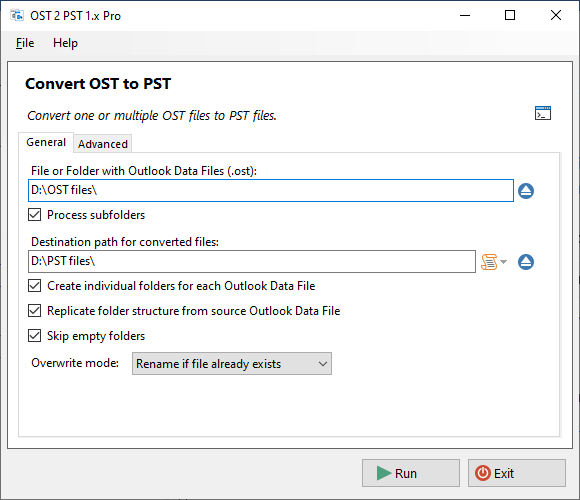
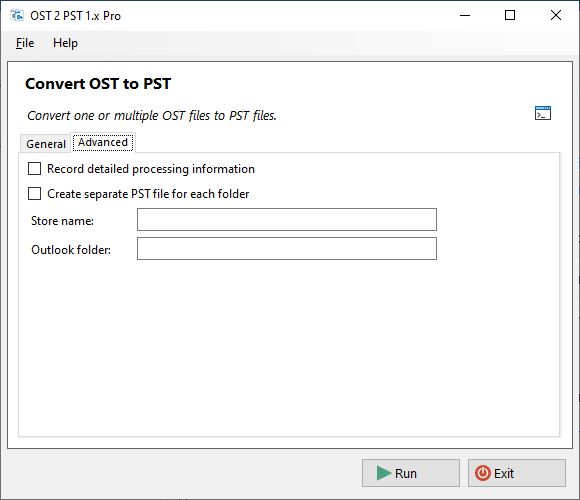
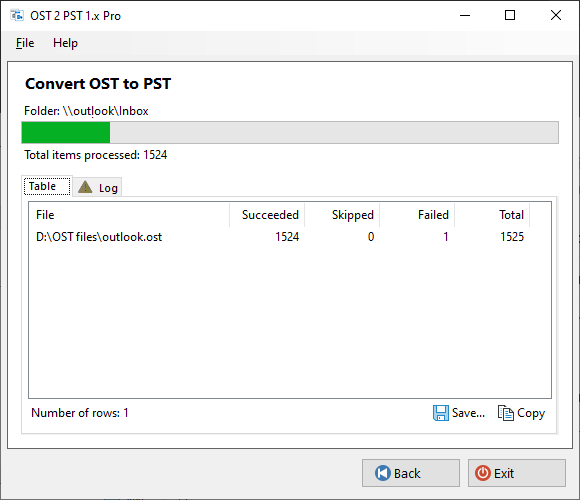
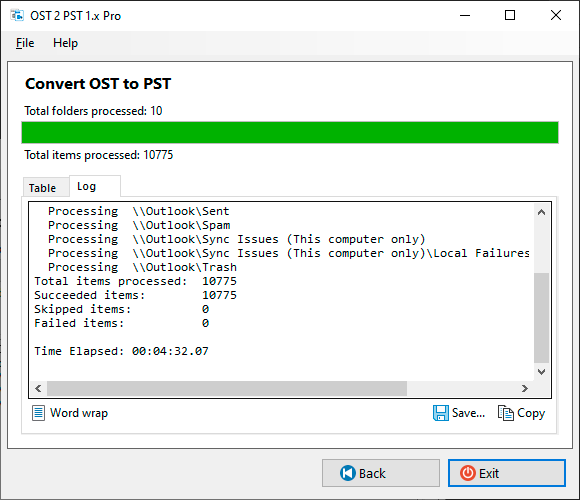
Convert OST File to PST in 3 Easy Steps
Frequently Asked Questions
Have questions about converting OST to PST? Find answers to the most common queries below.
The size of the resulting PST file does not necessarily match the size of the source OST file. Differences are normal and can occur for several reasons.
Reasons for a smaller PST file:
- OST files may contain deleted or outdated versions of items that are no longer needed. During conversion, only the current supported Outlook data is exported, so this unused data is not included in the PST file.
- OST and PST files use different internal storage structures, so the same Outlook data can occupy different amounts of disk space.
Reasons for a larger PST file:
- Make sure you are exporting to a new PST file rather than adding data to an existing one. Use the Overwrite mode option to control this behavior.
- The internal storage structure of the PST file and the Outlook version used to create it can affect its size.
- When exporting a large number of emails, Outlook may use additional space while creating and updating the PST file.
Classic Outlook has a default size limit of 20 GB or 50 GB for PST and OST files, depending on the Outlook version and configuration. If the resulting PST reaches this limit, you can increase the Outlook data file size limit or export the OST data into multiple smaller PST files.
The System.OutOfMemoryException error indicates that the system does not have enough available memory to complete the conversion. This can occur when processing a large OST file or a large amount of Outlook data.
If you are using 32-bit Microsoft Office, consider switching to 64-bit versions of all components required for the conversion. To process very large OST files more efficiently, we recommend using:
- Microsoft Windows (64-bit)
- Classic Microsoft Outlook (64-bit)
- OST 2 PST (64-bit)
Using 64-bit components removes the memory limitations of 32-bit applications and allows the converter to process significantly larger OST files.